
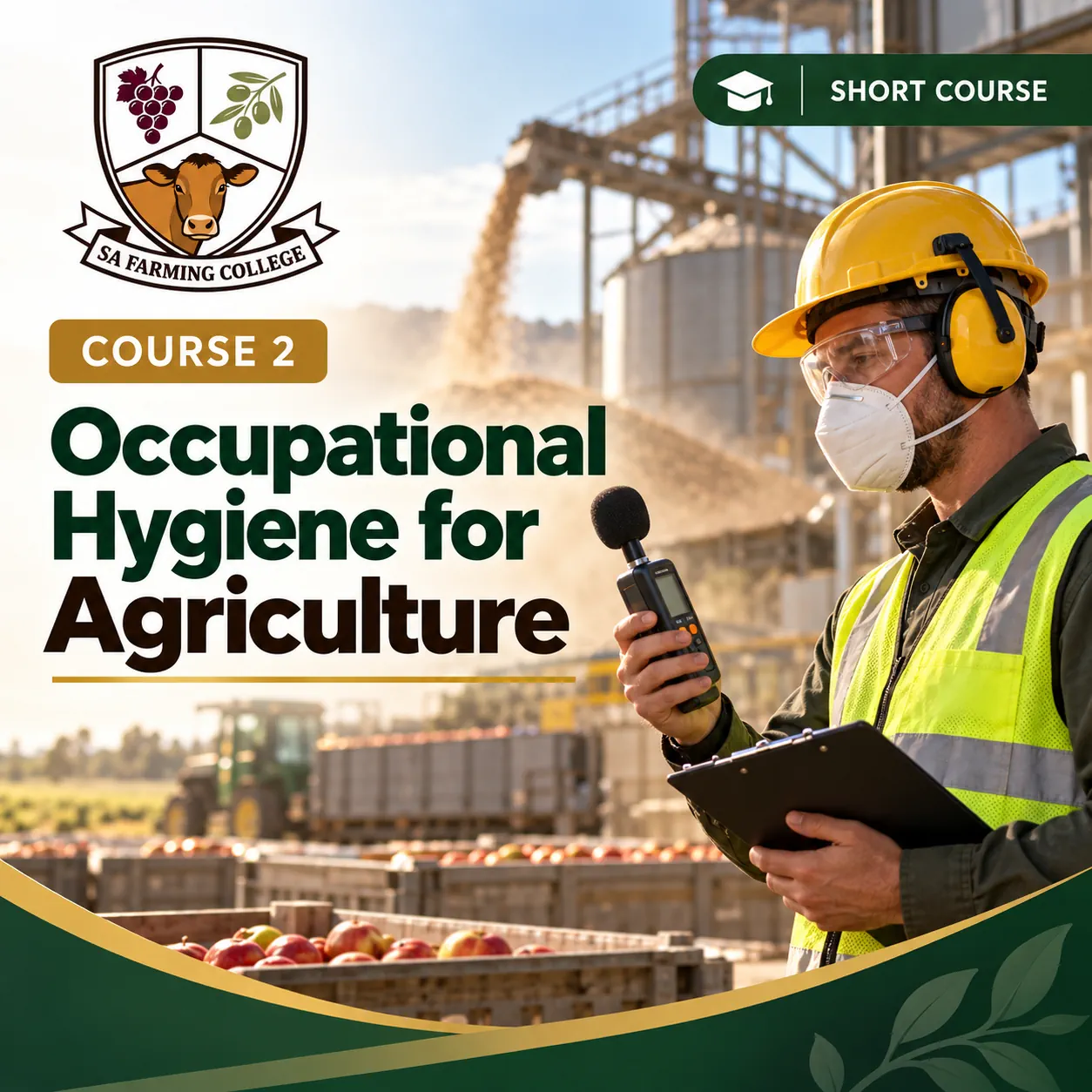
Occupational Hygiene for Agriculture
Original price was: R 1,200.00.R 600.00Current price is: R 600.00.
Course 2 of the SIZA-Aligned Farm OHS & Occupational Hygiene Training Series.
Learn to identify and manage workplace health hazards on South African farms and in packhouses.
This practical course covers occupational hygiene fundamentals, noise and hearing health, heat stress, dust and biological exposure, indoor air quality, vibration and workplace lighting, with an emphasis on effective risk controls.
Description
Course Overview
Course 2 of the SIZA-Aligned Farm OHS & Occupational Hygiene Training Series.
Protect the health and wellbeing of agricultural workers with our Occupational Hygiene for Agriculture course, designed to help South African farms and packhouses identify, assess and control workplace health hazards.
Offered by SA Farming College, this practical course introduces the fundamental principles of occupational hygiene and their application within agricultural environments.
Agricultural workers may be exposed to occupational health risks such as excessive noise, heat, dust, biological agents, vibration and inadequate workplace ventilation or lighting. Recognising these hazards and implementing appropriate controls is essential for protecting employees and supporting workplace health and safety compliance.
This course equips farm owners, managers, supervisors and health and safety personnel with practical knowledge of occupational health hazards, workplace exposure risks and effective preventative measures.
Rather than focusing solely on theoretical concepts, the training uses agricultural examples to demonstrate how occupational hygiene principles can be applied to everyday farming operations.
Course Highlights
- Practical, agriculture-focused occupational hygiene training
- SIZA-aligned workplace health and safety guidance
- Real-world farm and packhouse examples
- Noise, heat, dust, biological exposure and vibration management
- Workplace risk assessments and exposure control measures
- Online video lessons and knowledge assessment
- Self-paced learning through SA Farming College
What You Will Learn
Upon completion of this course, learners should be able to:
- Understand the fundamental principles of occupational hygiene and their importance in agriculture.
- Identify common occupational health hazards affecting farm and packhouse workers.
- Distinguish between workplace hazards, risks and occupational exposures.
- Recognise harmful noise exposure and understand the importance of hearing conservation.
- Identify heat stress risks and implement practical protective measures for outdoor workers.
- Understand the potential health effects of agricultural dust, mould and biological agents.
- Recognise workplace ventilation and indoor air quality concerns.
- Identify risks associated with whole-body vibration, hand-arm vibration and inadequate lighting.
- Apply practical workplace controls to minimise harmful occupational exposures.
- Recognise when specialist occupational hygiene assessments or exposure monitoring may be required.
- Understand how occupational hygiene assessments can support farm risk management and continuous improvement.
Course Content
Module 1: Occupational Hygiene Fundamentals
An introduction to occupational hygiene and the recognition, evaluation and control of workplace health hazards.
Topics include:
- Principles and objectives of occupational hygiene
- Understanding workplace hazards, risks and exposure
- Common occupational health hazards in agriculture
- Identifying physical, chemical and biological stressors
- Agricultural workplace risk assessment
- Understanding exposure pathways and potential health effects
- Recognising when specialist occupational hygiene assessments are required
- Practical workplace exposure control strategies
Module 2: Noise and Hearing Health
Understand the potential health effects of occupational noise exposure and the importance of protecting workers’ hearing.
Topics include:
- Common sources of agricultural workplace noise
- Noise exposure from tractors, machinery and packhouse equipment
- Noise-induced hearing loss and other health effects
- Identifying and assessing workplace noise risks
- Engineering and administrative noise controls
- Hearing protection and hearing conservation programmes
- Occupational health monitoring and audiometry where required
- Practical noise reduction measures for agricultural workplaces
Module 3: Heat and Outdoor Exposure
Explore the occupational health challenges associated with working outdoors and in demanding agricultural environments.
Topics include:
- Understanding occupational heat stress
- Heat-related illnesses and their warning signs
- Solar and ultraviolet radiation exposure
- Dehydration and physical workload
- Worker acclimatisation to hot environments
- Hydration, shade and rest arrangements
- Work scheduling and heat stress prevention
- Developing practical heat management procedures for farming operations
Module 4: Dust, HBA and IAQ
Learn how airborne contaminants, hazardous biological agents (HBA) and indoor air quality (IAQ) can affect worker health.
Topics include:
- Agricultural dust and airborne particles
- Dust exposure during harvesting, cleaning and material handling
- Mould, microorganisms and other biological hazards
- Respiratory health risks associated with workplace exposure
- Indoor air quality in packhouses, offices and enclosed work areas
- Workplace ventilation and housekeeping
- Exposure prevention and control measures
- Recognising when specialist assessment or monitoring may be necessary
Module 5: Vibration and Illumination
Understand the occupational health effects of vibration and inadequate workplace lighting in agricultural environments.
Topics include:
- Whole-body vibration from tractors and agricultural vehicles
- Hand-arm vibration from powered tools and machinery
- Potential health effects of occupational vibration exposure
- Identifying and assessing workplace vibration risks
- Equipment maintenance and exposure reduction measures
- Workplace lighting and visual task requirements
- Glare, poor illumination and visual discomfort
- Practical vibration and lighting control strategies
Who Should Enrol?
This course is particularly suitable for:
- Farm owners and agricultural business operators
- Farm managers and production managers
- Health and safety representatives
- Agricultural supervisors and team leaders
- Occupational health and safety personnel
- Human resources and compliance officers
- Agricultural technical and maintenance staff
- Packhouse managers and supervisors
Course Information
- Course Type: Short Course
- Study Mode: Self-Paced Online Learning
- Recommended Duration: 1 Day or 2 Half-Days
- Industry: Agriculture and Farming
- Focus: Occupational Hygiene and Workplace Health
- Assessment: Online Knowledge Quiz
- Certificate: SA Farming College Certificate, subject to successful completion requirements
- Applicable Frameworks: South African occupational health and safety legislation and SIZA-aligned health and safety practices
Why Choose This Course?
Not all occupational health hazards are immediately visible. Prolonged exposure to noise, dust, heat, vibration and other workplace conditions can affect agricultural workers’ health, safety and long-term wellbeing.
Understanding these risks is essential for creating healthier working environments, reducing occupational exposure and supporting effective workplace health and safety management.
This course provides a practical, agriculture-focused approach to recognising and managing occupational health hazards. Learners gain valuable knowledge of workplace exposure risks, preventative measures and the importance of occupational hygiene assessments.
Whether you operate a small farm or oversee health and safety responsibilities across a larger agricultural business, this training provides a useful foundation for improving occupational health practices.
Take the next step towards healthier, safer and better-managed agricultural workplaces with SA Farming College.
Important: This course provides educational training aligned with relevant SIZA health and safety principles. It is not an official SIZA qualification, audit or certification and does not replace applicable legislation, professional occupational hygiene assessments or specialist advice.
Additional information
| Course Type | Short Course |
|---|---|
| Study Mode | Self-Paced Online |
| Duration | 1 Day or 2 Half-Days |
| Provider | SA Farming College |
Only logged in customers who have purchased this product may leave a review.
Reviews
There are no reviews yet.