
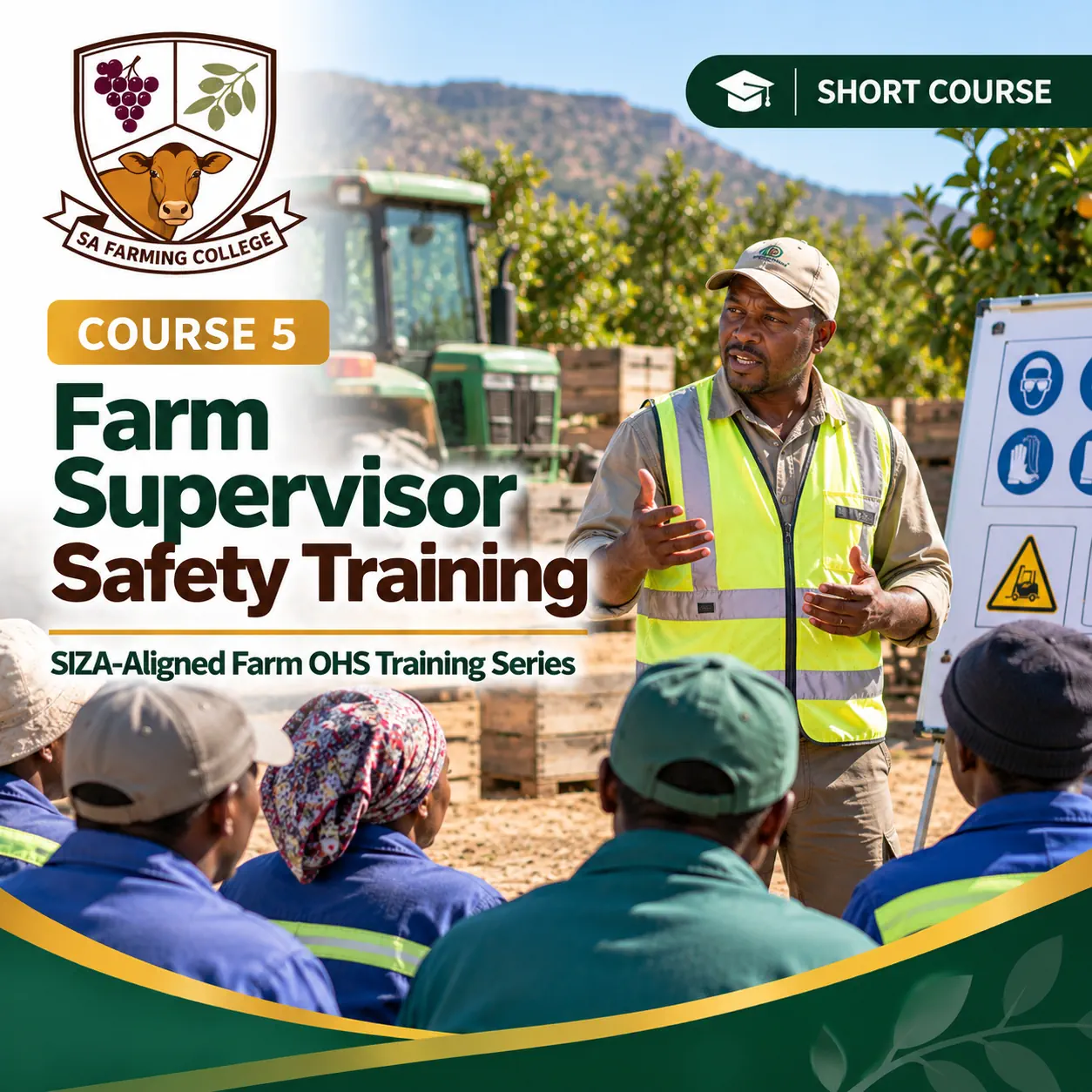
Farm Supervisor Safety Training
Original price was: R 1,200.00.R 600.00Current price is: R 600.00.
Course 5 of the SIZA-Aligned Farm OHS & Occupational Hygiene Training Series.
Develop the practical knowledge and leadership skills needed to promote safer working environments and manage everyday health and safety responsibilities on South African farms.
This course covers supervisor accountability, toolbox talks, worker communication, workplace inspections, hazard reporting, incident response and corrective-action management.
Description
Course Overview
Course 5 of the SIZA-Aligned Farm OHS & Occupational Hygiene Training Series.
Develop stronger safety leadership skills and promote safer agricultural workplaces with our Farm Supervisor Safety Training course, designed to help South African farm supervisors, team leaders and foremen manage everyday workplace health and safety responsibilities.
Offered by SA Farming College, this practical course focuses on frontline safety leadership, workplace inspections, hazard identification, worker communication and effective incident response within agricultural environments.
Farm supervisors play an important role in translating workplace health and safety policies into everyday practices. From coordinating harvest activities and supervising machinery operations to conducting safety briefings and responding to hazards, effective supervision is essential for protecting workers and maintaining safer farming operations.
This course introduces practical supervisory techniques that help identify unsafe conditions, communicate workplace risks, encourage safe work practices and ensure that corrective actions are implemented.
Through real-world agricultural examples, learners develop the knowledge needed to support workplace safety, improve worker engagement and contribute to a positive health and safety culture.
Course Highlights
- Practical, agriculture-focused supervisory safety training
- SIZA-aligned workplace health and safety guidance
- Frontline safety leadership and supervisor accountability
- Effective toolbox talks and worker communication
- Workplace inspections and hazard reporting
- Incident and near-miss response procedures
- Corrective-action planning and follow-up
- Online video lessons and knowledge assessment
- Self-paced learning through SA Farming College
What You Will Learn
Upon completion of this course, learners should be able to:
- Understand the role and responsibilities of farm supervisors in maintaining workplace health and safety.
- Recognise how effective supervision contributes to safer agricultural operations.
- Identify unsafe working conditions, practices and potential workplace hazards.
- Conduct effective pre-task safety briefings and toolbox talks.
- Communicate workplace risks and safety procedures clearly to agricultural workers.
- Understand the importance of language, literacy and practical demonstrations in worker training.
- Carry out routine workplace safety inspections.
- Identify, report and prioritise workplace hazards and safety concerns.
- Recognise when unsafe work must be stopped or escalated to management.
- Respond appropriately to workplace incidents, accidents and near misses.
- Understand the importance of accurate incident reporting and fact-based investigations.
- Identify corrective and preventative actions to reduce recurring workplace risks.
- Promote worker participation, accountability and continuous safety improvement.
Course Content
Module 1: Supervisor Accountability
Understand the responsibilities of frontline supervisors and their role in implementing effective workplace health and safety practices.
Topics include:
- Introduction to farm supervisor safety responsibilities
- Understanding supervisory accountability
- Translating workplace safety procedures into daily practices
- Identifying and communicating task-specific hazards
- Conducting daily safety briefings
- Monitoring high-risk agricultural activities
- Recognising unsafe conditions and work practices
- Addressing workplace safety concerns without unnecessary blame
- Understanding stop-work and escalation procedures
- Recording and following up on outstanding safety actions
- Encouraging worker participation in workplace safety
Module 2: Toolbox Talks and Worker Communication
Learn how to communicate workplace health and safety information effectively through practical, task-specific discussions and worker engagement.
Topics include:
- The purpose and importance of toolbox talks
- Planning short, relevant safety briefings
- Identifying task-specific hazards and control measures
- Communicating risks before agricultural work begins
- Using demonstrations and visual safety information
- Addressing language and literacy challenges
- Encouraging worker questions and feedback
- Confirming worker understanding of safety instructions
- Recording training topics and attendance
- Identifying and escalating worker safety concerns
- Maintaining consistent safety communication during seasonal operations
Module 3: Inspection and Hazard Reporting
Develop the knowledge needed to conduct workplace inspections, identify potential hazards and support effective corrective-action management.
Topics include:
- The importance of regular workplace safety inspections
- Identifying hazardous conditions and unsafe work practices
- Inspecting agricultural equipment, machinery and work areas
- Recognising high-risk workplace defects
- Identifying hazards involving ladders, machinery, chemicals and protective equipment
- Conducting structured workplace inspections
- Reporting and documenting identified hazards
- Assessing and prioritising safety concerns
- Taking immediate action where serious risks are identified
- Assigning corrective actions and responsible persons
- Monitoring and verifying completion of safety improvements
- Encouraging workers to report hazards and near misses
Module 4: Incident and Near-Miss Response
Understand how supervisors should respond to workplace incidents, protect employees and contribute to effective investigations and preventative actions.
Topics include:
- Understanding workplace incidents and near misses
- Recognising the importance of immediate emergency response
- Protecting workers and preventing further harm
- Following workplace emergency procedures
- Reporting incidents to appropriate personnel
- Collecting and recording factual incident information
- Identifying witnesses and relevant evidence
- Understanding immediate, underlying and system-related causes
- Avoiding blame-based incident investigations
- Developing appropriate corrective and preventative actions
- Reviewing workplace risks following incidents
- Communicating lessons learned to workers
- Supporting continuous improvement in workplace safety
Who Should Enrol?
This course is particularly suitable for:
- Farm supervisors and agricultural team leaders
- Farm foremen and senior agricultural workers
- Harvest supervisors and production team leaders
- Packhouse line leaders and supervisors
- Agricultural operations supervisors
- Farm managers responsible for supervising workers
- Individuals preparing to take on agricultural supervisory responsibilities
Course Information
- Course Type: Short Course
- Study Mode: Self-Paced Online Learning
- Recommended Duration: Half Day (4 Hours), or 1 Day with Field Practical
- Industry: Agriculture and Farming
- Focus: Farm Supervision, Safety Leadership and Occupational Health & Safety
- Assessment: Online Knowledge Quiz
- Certificate: SA Farming College Certificate, subject to successful completion requirements
- Applicable Frameworks: South African occupational health and safety legislation and SIZA-aligned health and safety practices
Why Choose This Course?
Farm supervisors are often the first people to identify unsafe conditions, respond to worker concerns and address emerging workplace risks.
Effective safety supervision goes beyond enforcing rules. It involves clear communication, recognising hazards, supporting workers and ensuring that appropriate preventative measures are implemented.
This course provides a practical, agriculture-focused approach to developing frontline safety leadership skills, helping supervisors understand their responsibilities and manage everyday workplace health and safety challenges.
Whether you supervise a small agricultural team, oversee seasonal harvesting operations or manage workers in a commercial farming environment, this training provides valuable knowledge to support safer and better-organised workplaces.
Take the next step towards stronger safety leadership and safer agricultural workplaces with SA Farming College.
Important: This course provides educational training aligned with relevant SIZA health and safety principles. It is not an official SIZA qualification, audit or certification and does not replace applicable legislation, professional occupational health and safety advice or any required workplace-specific competency training.
Additional information
| Course Type | Short Course |
|---|---|
| Study Mode | Self-Paced Online |
| Duration | Half Day (4 Hours) |
| Provider | SA Farming College |
Only logged in customers who have purchased this product may leave a review.
Reviews
There are no reviews yet.